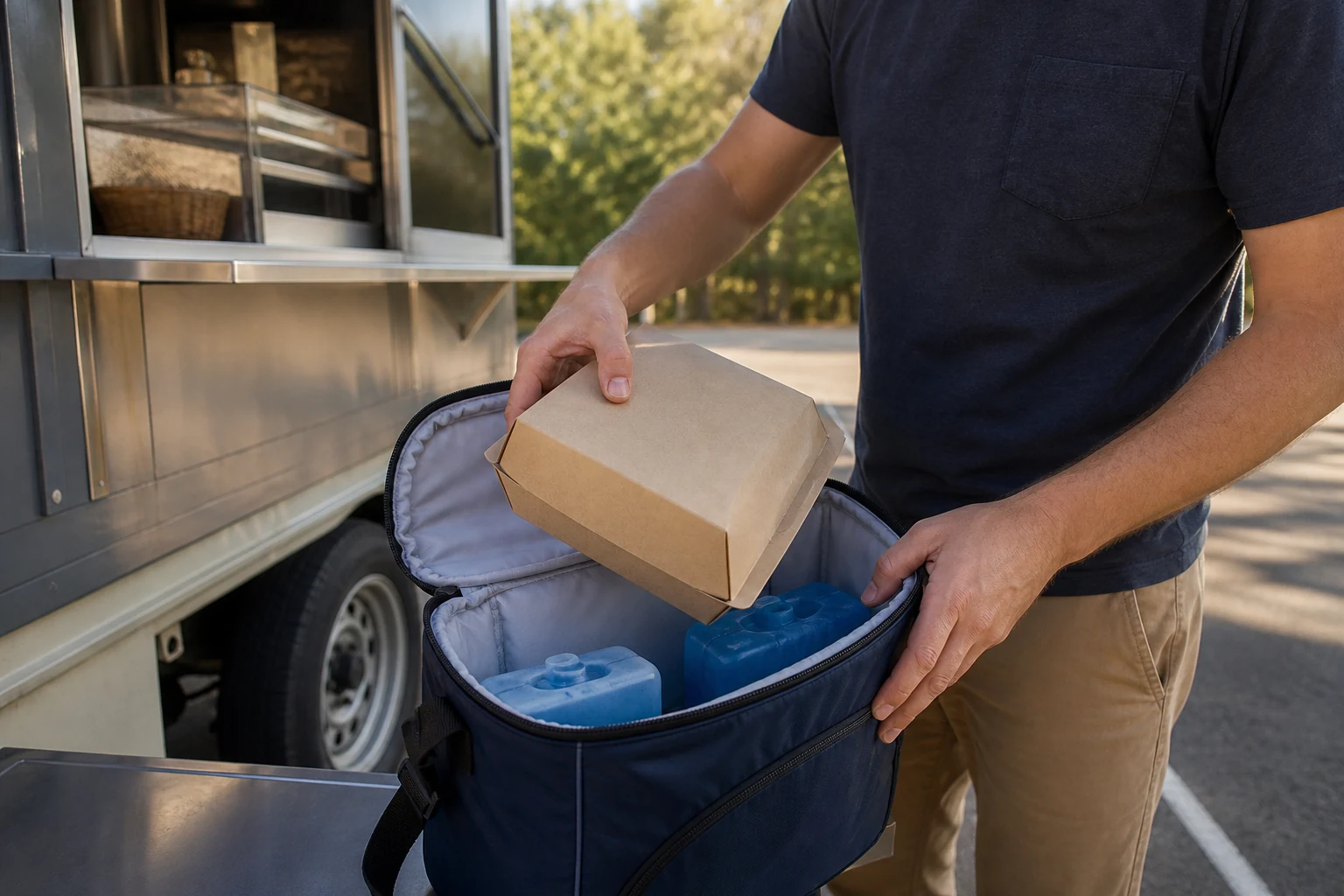
The clock includes the time spent finishing the meal, talking, walking back to the car and driving home. The federal FoodSafety.gov guide to restaurant leftovers says perishable food should go directly home rather than accompanying more stops, while its broader safety guidance uses a two-hour limit—or one hour above 90°F. That is a decision limit, not a target to use up.
Start with the real journey. A ten-minute drive to a refrigerator is different from an afternoon of errands. Hot food should stay hot if it will be eaten promptly; food meant for later needs a quick route to refrigeration. A parked car is not controlled storage, even when the container is still warm.
Make the transport decision before the box closes
If you know there will be a long drive, bring a clean insulated bag and frozen cold packs. Put the closed container into the bag promptly rather than leaving it on a sunny seat or in the trunk. Keep the bag closed and separate it from anything that could leak onto ready-to-eat food.
If the food has already sat out during a meal, count that time too. Do not reset the clock because the lid went back on. When you cannot tell how long a perishable dish has been unrefrigerated—or it has exceeded the official time limit—the safer choice is to discard it rather than trying to rescue it with a refrigerator or microwave.
| What happens next? | Practical move | What not to assume |
|---|---|---|
| Eating immediately | Keep it hot and finish promptly. | A closed box does not control temperature. |
| Short trip home | Go directly to the refrigerator. | Running errands does not stop the clock. |
| Longer or hot-weather trip | Use an insulated bag with cold packs. | A car cabin or trunk is not a cooler. |
Use shallow containers once you arrive
At home, move a large portion into smaller, shallow containers so it cools more evenly. The federal four-step food-safety guide specifically recommends shallow containers and prompt refrigeration for quick cooling. There is no need to wait for a deep box of food to become completely cold on the counter.
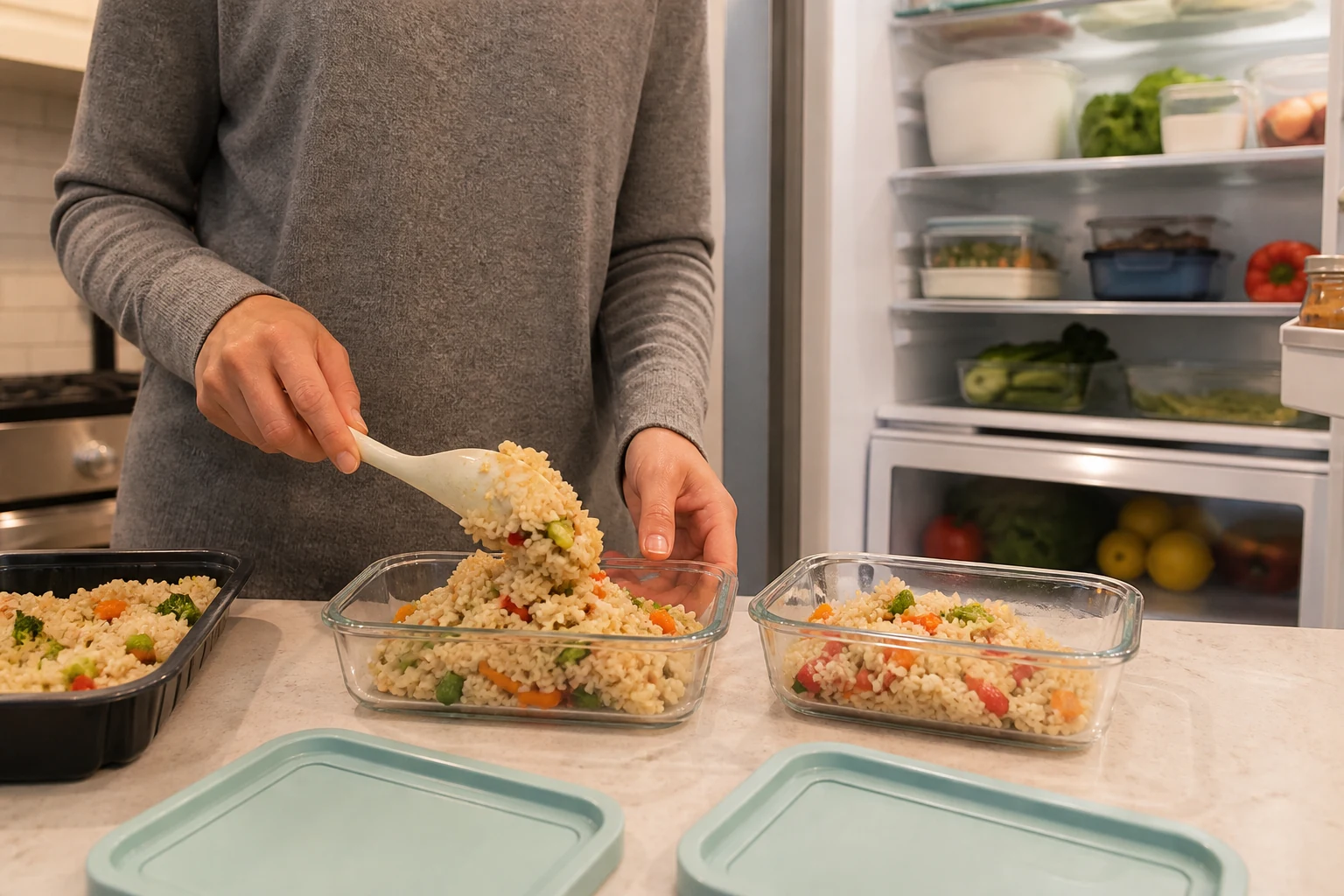
Cover the containers, mark the date in whatever way already works in your kitchen and place them where the refrigerator air can circulate. The FDA food-waste and safety guidance advises refrigerating or freezing leftovers within two hours and storing refrigerated food in covered containers or sealed bags.
Keep the original components in mind. A grain bowl, cooked meat, seafood, gravy or dairy-based sauce is perishable even when some parts of the meal look dry. Smell and appearance can help you notice spoilage, but they cannot prove that food was handled safely. Time and temperature are the better record.
Reheat a portion, not the whole supply
Take out only the amount you plan to eat. Reheat leftovers thoroughly and stir or rotate dense foods so there are no cold pockets. The federal safe-temperature chart lists 165°F for leftovers, measured with a food thermometer. Sauces, soups and gravies should be brought to a rolling boil during reheating.
Repeatedly warming the full container and returning it to the refrigerator creates more handling and more time outside cold storage. Portioning on the first night makes the next meal simpler: one container can be reheated while the rest stays cold.
Know when the plan has already failed
Discard perishable leftovers if the time out of temperature control is beyond the official limit, if the container leaked and cross-contaminated the food, or if you cannot establish a reasonable timeline. Extra heat later does not undo every problem caused by poor storage.
Also be stricter when serving people at higher risk of foodborne illness, including young children, older adults, pregnant people and anyone with a weakened immune system. This guide is a practical handling routine, not medical advice; individual health questions belong with a clinician.
The safest takeaway routine begins before you leave the truck: count the real time, use cold packs when the trip demands them, divide food into shallow covered containers and reheat only one portion. A small plan at the window protects both the meal you enjoyed and the one you hope to enjoy tomorrow.